
Governance
Your Team Is Already Using AI. You Just Didn’t Choose It.
DeAnn Haley ·
Ask most firm leaders whether their people are using AI, and they'll tell you yes. They know it's there. What they usually can't tell you is what's being used, where, and why.
That's not a knock on leadership. It's how AI tends to show up. The research backs this up, and so does our own experience.
In most firms, AI didn't arrive through a deliberate strategy. It arrived through individuals. Someone in operations started cleaning up meeting notes with an AI assistant. Someone else began drafting emails with it. A principal used it to summarize a long report late one night. None of it was planned, approved, or written down. It just happened, one login at a time.
There's a name for this: shadow AI. It's AI that enters a firm through individual choices instead of a leadership decision.
What the research shows
Schwab's latest study of AI in RIAs puts numbers to it:
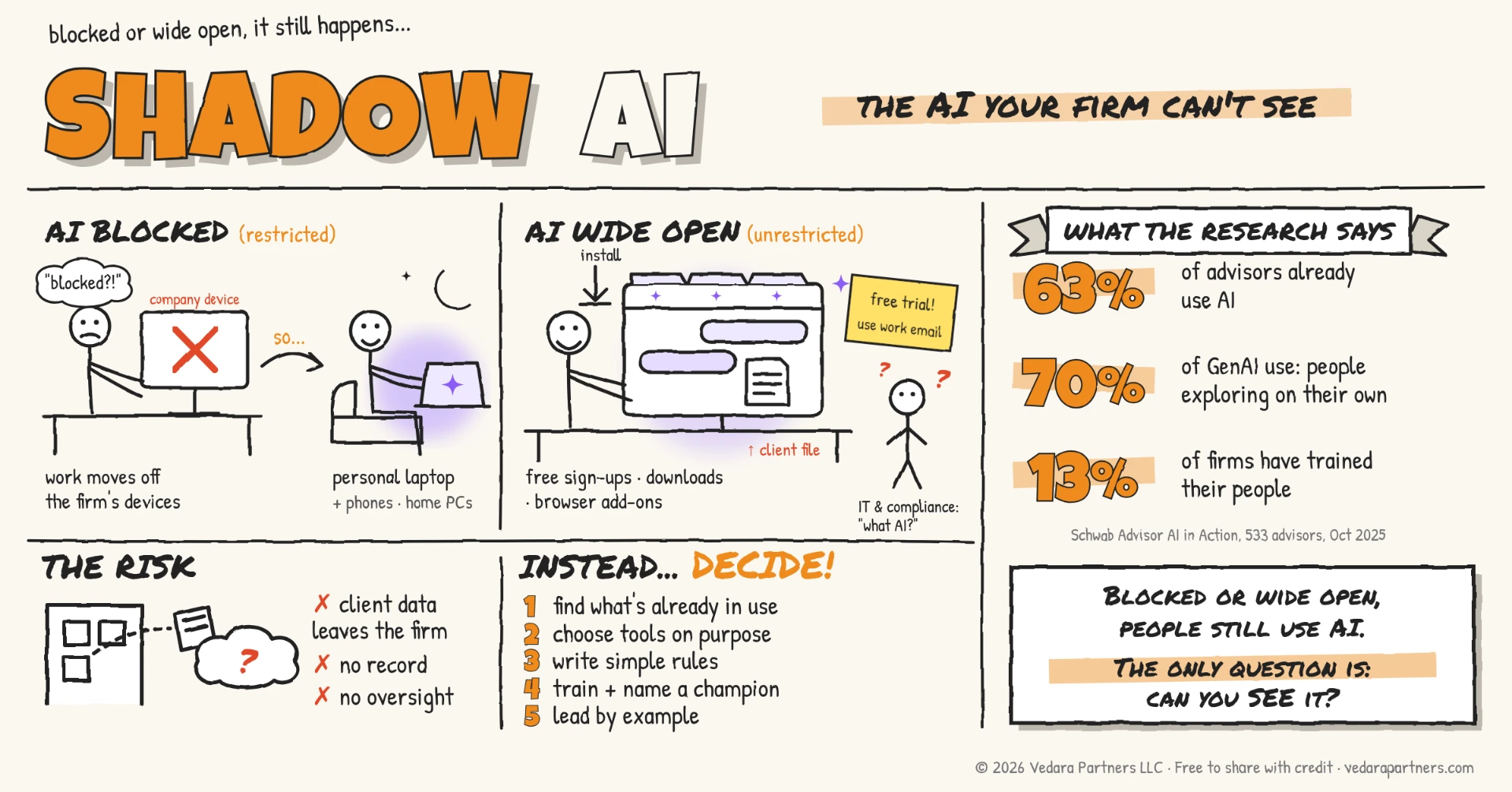
- 63% of advisors say they're already using AI.
- Among those using generative AI, the most common path is individuals exploring tools on their own (70%), not firm-built tools or tools connected across departments.
- 40% of firms have used a general-purpose AI assistant to help draft client communications.
Now look at what firms have put around that usage:
- Only 18% have communicated an AI vision to their teams.
- Only 19% have named an AI champion.
- Only 13% have provided AI training.
- 48% have taken none of the leadership steps Schwab measured.
The usage is real. The structure around it mostly isn't. That gap is the story.
We've seen this pattern before
This isn't unique to advisory firms. We've spent years inside large enterprise firms, and our experiences there show the same thing: AI adoption almost always starts from the bottom up. People find tools that save them time, and they start using them long before anyone at the top has a plan.
Many large enterprise firms tried to solve this by blocking AI altogether. They shut off AI websites and tools on company networks and devices. It feels like the safe choice. In practice, it often makes the problem worse.
The need doesn't go away just because the tools are blocked. People still have work to get done, and they know AI can help. So they turn to their personal phones and home computers to do what they can. Now the work is happening completely outside the firm's view, on devices the firm doesn't manage, with no policy, no oversight, and no record of what was shared.
Blocking AI doesn't stop people from using it. It just stops the firm from seeing it.
We've also seen where this leads if no one steps in. It's the same story as every other wave of technology. Each tool made sense to someone at the time. No one set out to build a tangled mess of overlapping systems. But that's what you end up with when nobody chooses, and cleaning it up later costs far more than deciding up front. We've watched large enterprise firms spend real time and money consolidating a dozen or more platforms down to one.
AI is on the same path. It's just moving much faster.
If large enterprise firms with dedicated security and technology teams can't keep AI out, smaller firms, where one person may be covering compliance, operations, and technology all at once, should assume it's already happening.
This isn't a people problem
The people using these tools aren't doing anything wrong. They're curious, they're busy, and they found something that helps. That's exactly the instinct you want on your team.
The problem is that no one made the call. And when no one makes the call, the tools get picked by whoever signed up first.
What's at stake when no one chooses
For a firm that manages client money, "we didn't choose it" is more than a tidiness issue.
Client data. When someone pastes client information into a personal AI account, or does the work on a personal device, that data has left your control. Regulation S-P already requires firms to oversee the service providers that handle customer information. That obligation doesn't pause because the vendor is an AI tool someone signed up for on their own.
Your records. If AI helped write a client communication, your existing supervision and recordkeeping obligations still apply. There's no AI exemption. The first question is a simple one: would you even know it happened?
Consistency. Five people using five tools in five different ways means five different levels of quality going out under your firm's name.
The bigger opportunity. This is the one that gets overlooked. Scattered use keeps AI stuck at the individual level, saving one person a few minutes here and there. Firms that choose on purpose can apply it to the workflows that actually move the business: client service, operations, and growth.
How to take it back
Fixing this doesn't mean shutting anything down. It means deciding. Here's where we'd start:
- Find out what's actually in use. Ask your team, and make it a no-blame conversation. You can't manage what you don't know about, and people will only tell you if they don't expect to get in trouble for it.
- Choose on purpose. Pick the tools the firm will support based on how they handle your data, not on who found them first. Business and enterprise versions of these tools exist for a reason.
- Write the rules down. Schwab's own guidance is that every firm should have an AI acceptable use policy, whether it's using AI or not. Keep it short and practical: which tools are approved, what data can go into them, and when a person has to review the output.
- Name a champion and train people. Find someone who's already curious and give them the time and backing to help others. Then give everyone real, hands-on training, not a one-time memo.
- Lead from the top. People follow what leaders do, not what they say. When principals visibly use the approved tools the right way, the rest of the firm follows.
The real question
Your firm is going to use AI. That part has already been decided, by your team, one login at a time.
What's still open is whether leadership decides how. The firms that get this right won't be the ones with the most tools. They'll be the ones that chose deliberately and gave their people a clear, safe way to use what they chose.
So here's a question worth sitting with: if someone asked you today which AI tools your firm uses, and what client data goes into them, could you answer with confidence?
Sources: Schwab Advisor Services, "Schwab Advisor AI in Action" (survey of 533 advisors, fielded October 2025); Schwab Advisor Services, 2025 Independent Advisor Outlook Study (912 advisors, fielded July–August 2025).
Want a copy to share with your team?