Governance
Who Is Looking Out for Your Best Interests in AI?
DeAnn Haley ·
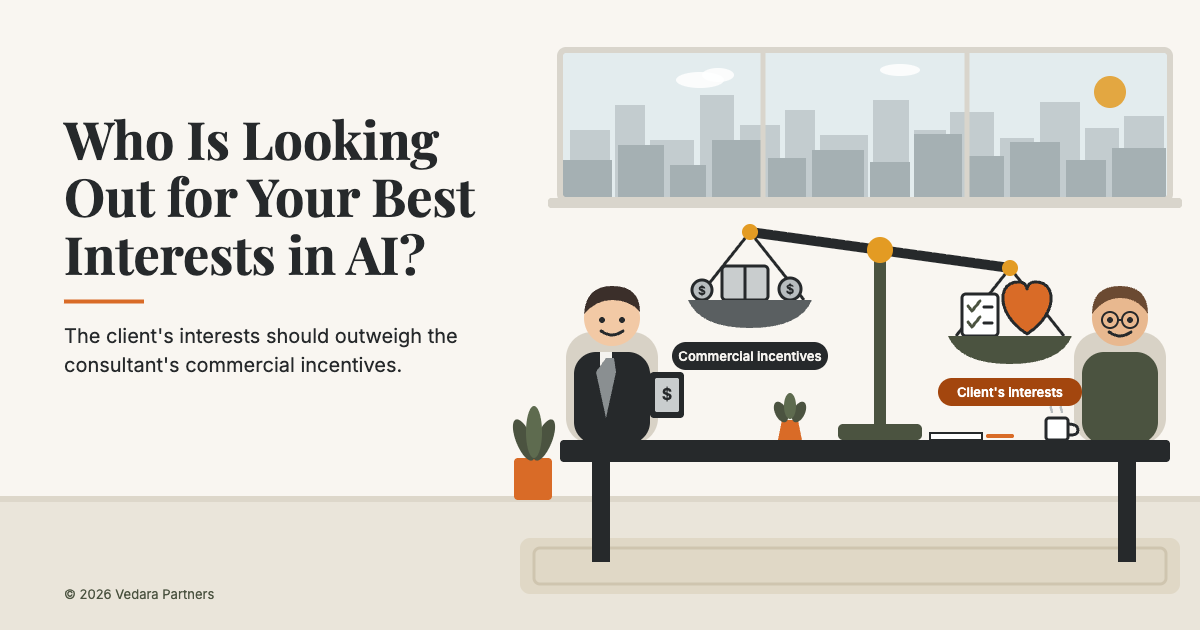
If you run an RIA, you already know the rule. You don't recommend a product because the provider is a friendly partner. You start with the client: their goals, their situation, their risk. The product comes last.
Now think about the last AI pitch you sat through. Where did it start?
My guess is a tool. A platform demo. A "solution." Someone showed you what it could do before anyone asked what you needed.
That's backwards. And I think RIAs should say so.
The test you already use
Here's the question I keep coming back to:
If you wouldn't recommend an investment to a client simply because your firm had a relationship with the product provider, why would you accept AI advice that starts with a predetermined technology?
It's the same problem with a different product. When the answer is picked before the question is asked, it isn't advice. It's a sales process. There's nothing wrong with selling. It just shouldn't be called strategy.
An AI "fiduciary" mindset
Your clients expect four things from you, and you should expect the same four from anyone advising you on AI.
- Objectivity: the advice starts with your firm's needs, not a preferred product.
- Transparency: partnerships, referral fees, and incentives are disclosed up front.
- Judgment: real alternatives are weighed, including doing less or doing nothing.
- Best interest: success is measured by your firm's results, not by what gets sold.
I call this an AI "fiduciary" mindset. To be clear, it's a standard to hold people to, not a legal designation. AI consultants aren't fiduciaries in the regulatory sense, and none should claim to be.
Why AI advice so often starts with the product
This isn't a character flaw. It's how the incentives work. A platform vendor sells its platform. An implementation partner builds what it knows. A consulting team that has delivered the same kind of solution ten times will tend to recommend it an eleventh. None of that is sinister.
But it means the conversation often starts in the wrong place: with a tool, instead of with your business problems and the results you want. When the answer comes first, the questions get shaped to fit it. Workflows bend around a product's features. Alternatives never reach the table.
A common version of this is the ready-made use case. Pre-meeting prep. Post-meeting notes. Email drafts. They're real problems for some firms. But they may not be yours, or yours may look different: a different CRM, messy data, a compliance step the tool never sees. A solution that fits the average firm can still miss yours. The right starting point is where work actually gets stuck in your firm, not a list of what the tool can do.
Specialists aren't the problem
Let me be fair here. A consultant who specializes in one platform can be very valuable. They know it deeply, they know where it breaks, and they can build fast. If you've already decided on a tool, a specialist might be the path you choose.
The issue is when implementation advice gets presented as objective strategy. The pitch sounds like "here's where AI fits in your firm," and the answer always happens to be the thing they install. So the question isn't whether specialists are good. It's whether you know what kind of advice you're getting.
The fix is simple. Ask what else they looked at.
The best advice may not be a purchase
Sometimes the right recommendation is to buy nothing. It might mean:
- Using technology you already own
- Fixing a workflow before you automate it
- Connecting the systems you have instead of adding another one
- Using different AI models for different jobs
- Deciding that a particular problem doesn't need AI at all
Here's where I think most AI advice stops short. The biggest gains rarely come from the tool. They come from rethinking how work happens across your people, processes, data, and systems. Sometimes the right answer isn't a different AI model at all. It's a different way of working: who does what, where the handoffs are, which steps simply go away. Objective technology advice has to be willing to say that, even when the tool isn't the star.
For 21 years at a large asset manager, I watched this happen. A business partner would bring me a new product/technology and ask us to onboard it. They had been to a conference or sat through a vendor demo, where they were shown a new tool that solved problems they didn't even know they had. When we did the analysis, nine times out of ten, it was a process, data, or ownership problem, not a technology problem at all. The tool wouldn't have fixed it.
What matters isn't which technology wins. It's whether the firm does.
Five questions to ask any AI advisor
Before you sign anything, ask:
- Who benefits if I say yes? Fees, resale margins, referral arrangements, partnerships. You're entitled to know.
- What else did you consider, and why did you rule it out? A real evaluation leaves a trail.
- Could something we already own solve this? If they can't answer, they haven't looked.
- How will we measure success? And what happens if we miss it?
- What would you recommend if implementing a new AI product wasn't an option? This shows whether they understand your problem or only their product.
Hold us to it, too
This isn't aimed at any one vendor or firm. It's aimed at the whole industry, and that includes Vedara. We have a point of view and we work with specific tools. It would be easy to say "we're vendor-neutral" and leave it there, but that isn't a promise anyone can check. So here's what we commit to:
- We explain the alternatives we considered, including ones that don't involve a purchase.
- We disclose material vendor relationships up front.
- We recommend using technology you already own when that's the right answer.
- We measure our work against business outcomes we agree on before we start.
- We act as a long-term partner, with your firm's best interests at the center of every recommendation.
The AI market is only going to get louder. The firms that do well won't be the ones that bought the most. They'll be the ones that got advice they could trust.
So as you weigh the growing number of AI consultants, platforms, and solutions competing for your attention, ask yourself one thing:
Is this recommendation being made because it's right for my firm, or because it's the product someone is selling?
Want a copy to share with your team?