AI in practice
AI Work Is Never "One and Done"
Vedara Partners ·
Most technology projects have a finish line. You scope it, build it, launch it, and move on to the next thing on the list. AI agents don't work that way — and the firms that keep treating them like they do are going to spend real money on things that don't hold up.
The ground moves faster than the calendar
A year ago, a "skill" you'd give an AI model was a folder of instructions — a way to remind it what you wanted, every conversation, because it couldn't act on its own. Anthropic introduced the idea in October 2025. Two months later, skills became an open standard with real enterprise controls behind them. By this year, that same idea can execute code, call other tools, and chain itself together with other skills to finish a job start to finish, no hand-holding required.
That's the part worth sitting with. What used to take a team months of custom engineering to teach an agent — a new capability, a new integration, a new way of handling a task — now often ships as something you install in an afternoon. That's genuinely exciting. It also means whatever you built and walked away from six months ago is already running on last year's rules, whether you've noticed or not.
Build what creates differentiated business value. Don't spend heavily recreating capabilities the AI platforms are likely to make standard — and never assume today's implementation is the finished version.
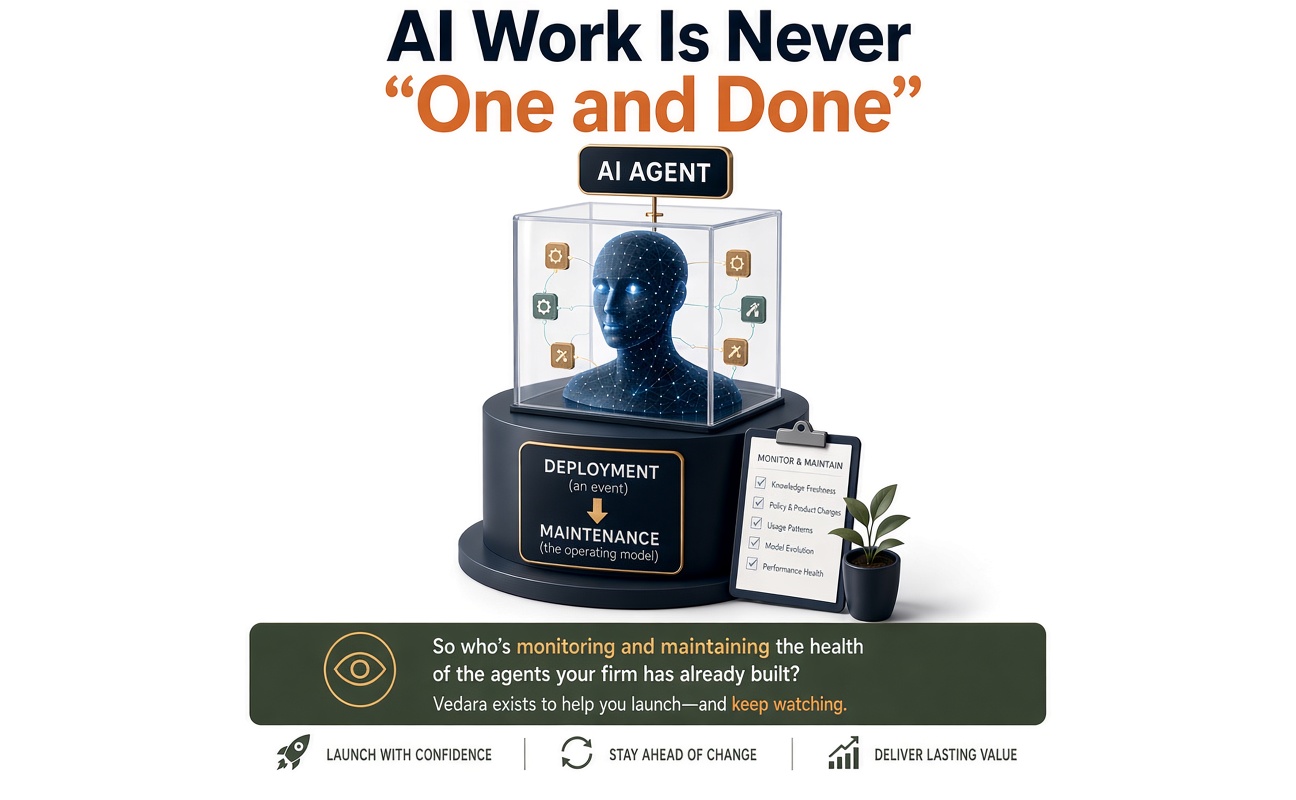
Deployment is an event. Maintenance is the operating model.
There's a phrase from the AI agent world that firms building their own agents should tattoo somewhere visible: deployment is an event, maintenance is the operating model. Agents don't fail loudly. They drift — the knowledge behind them goes stale as policies and products change, the patterns they were built around shift as usage changes, and performance quietly erodes long before anyone notices in a client meeting.
On top of that, the model underneath the agent keeps moving. Anthropic alone shipped seven new Claude versions between September 2025 and July 2026 — some less than three weeks apart, none more than about ten. That's not a once-a-year technology refresh. And evaluating whether to adopt each new version is real engineering work in its own right — often measured in weeks, not hours. An agent running at real scale typically needs a standing owner watching all of this, not a project team that built it and disbanded. For a firm just starting out, that doesn't mean a full department. It means someone whose job includes checking back in — quarterly at minimum, sooner around a major model release — and asking what the agent could do now that it couldn't when it was built.
This is a stage, not a finish line
Deloitte's most recent research on agentic AI in wealth management makes the shape of this clear. Right now, 73% of advisory firms use AI in some capacity, but only 6% use agentic tools, and just 5% have any cross-system integration. Almost the entire industry is still at the starting line.
The firms further along aren't there because they built one good thing and stopped. Deloitte's data shows a progression: firms using AI as a simple assistive tool see something like a 32% productivity gain. Firms that have embedded copilots into actual workflows see 57%. Firms operating what they call "AI-native," with adviser-supervised end-to-end automation, see gains over 100%. Nobody skips from stage one to stage three in a single build. You get there by staying in motion — revisiting, rebuilding, upgrading the parts the model has outgrown — not by shipping once and calling it strategy.
Build it. Don't call it done.
The firms that will pull ahead over the next few years aren't the ones with the most sophisticated launch — they're the ones who got comfortable revisiting what they built, on a cadence closer to the model's than their own fiscal year.
That's the piece most firms skip, and it's a big part of why Vedara exists — not just to help you launch something, but to make sure someone's still watching it after you do.
So who's monitoring and maintaining the health of the agents your firm has already built?
Sources: Deloitte, "The agentic AI productivity wave is heading for wealth management" (2026); Anthropic Claude release notes.
Want a copy to share with your team?